Cernunnos – Celtic God of Things

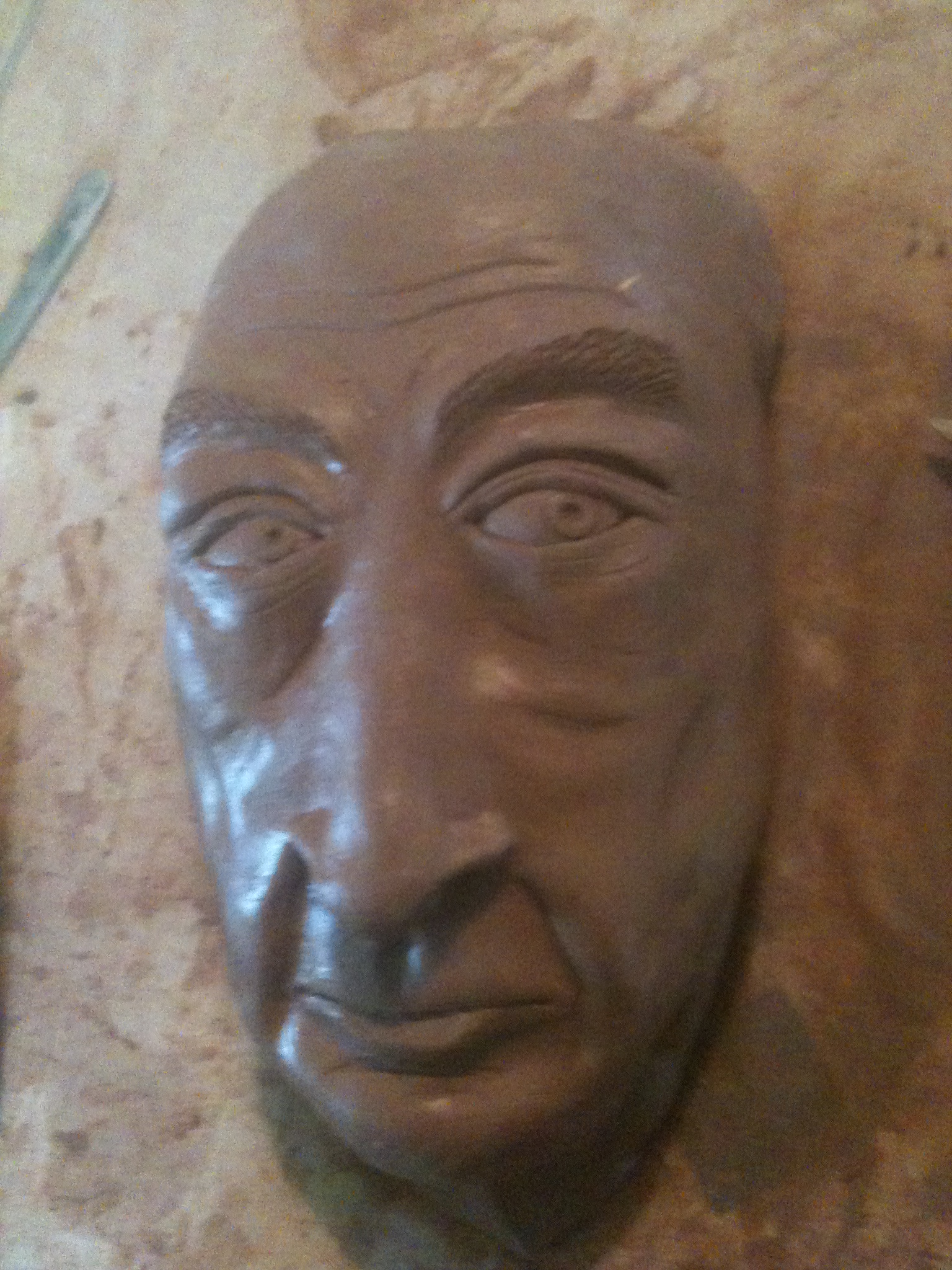
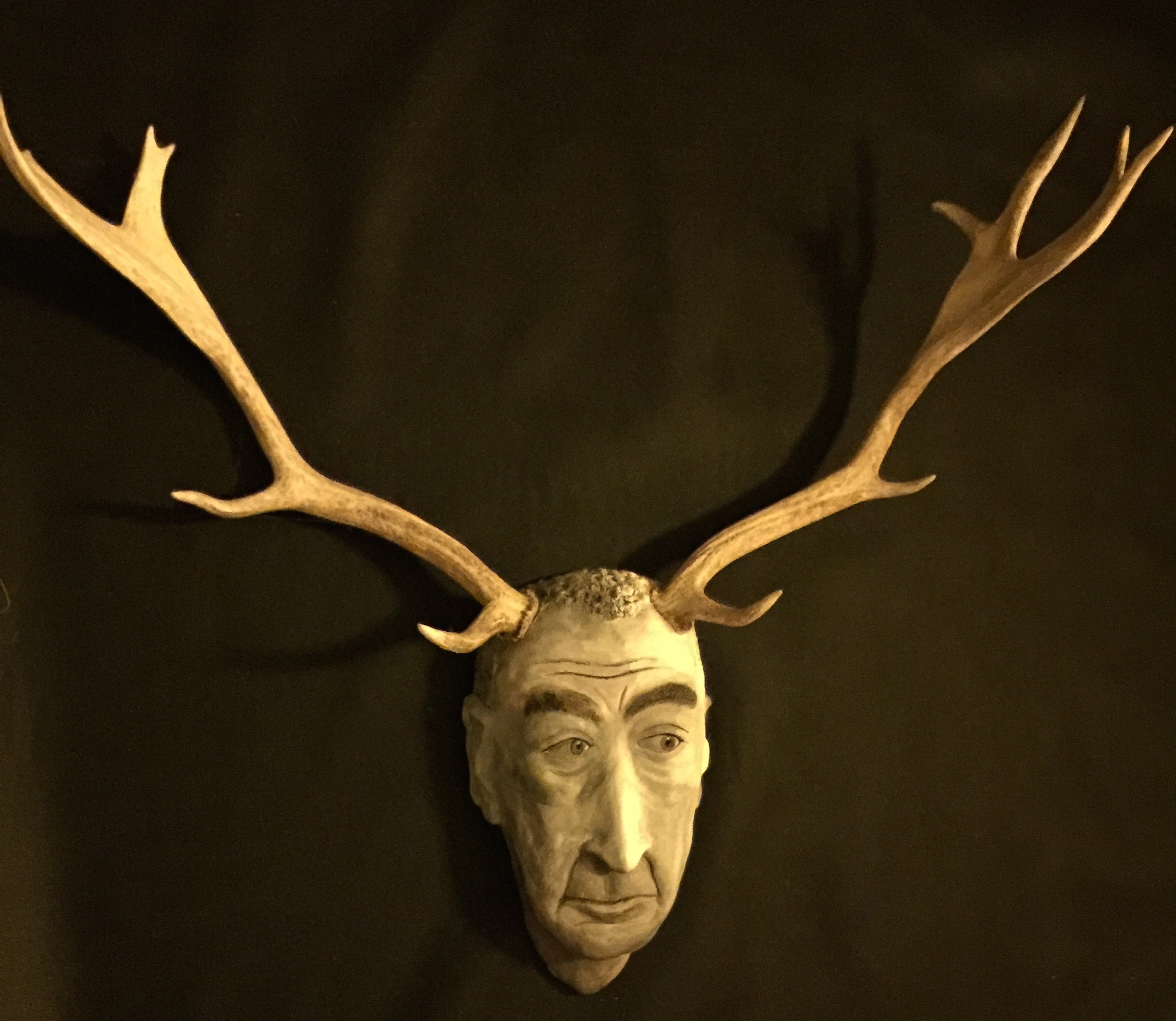
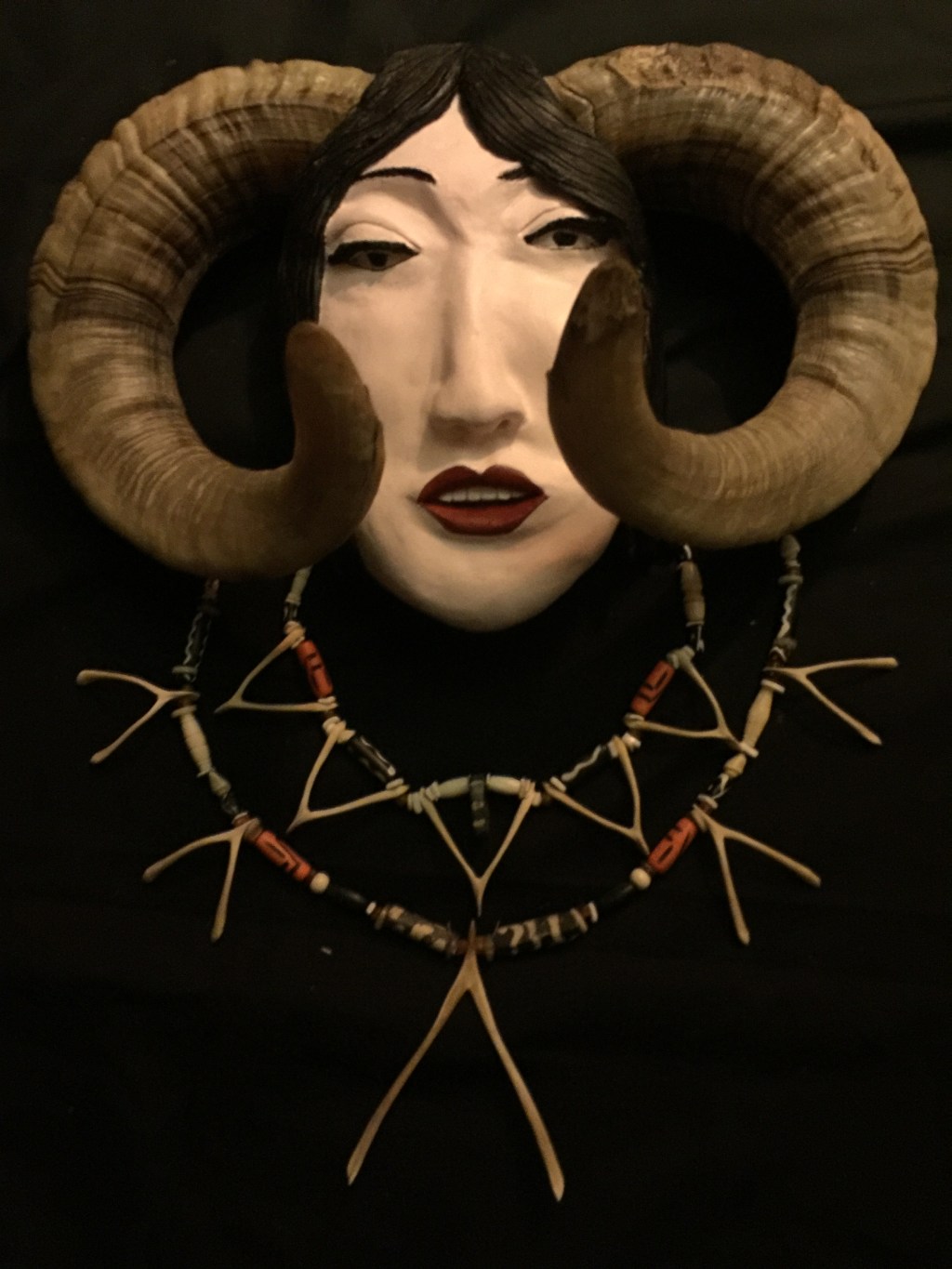
It’s early January 2015. It’s slow this time of year on Mayne so it’s a good time to turn ones focus toward creative projects. For reasons murky even to myself, I have created a series of ceramic masks adorned with horns and antlers. If I take a moment to ponder my motivations and goals for doing so, I’d say that my efforts are an amalgam of: the simple pleasure of creating with ones hands; the changes that accrue with any creative process over long periods of time; and the vague desire to impart some kind of meaning or significance to my creative process –  with varying degrees of conviction.

Somewhere during this intermittent 40-year plus exploration into ceramic mask making, antlers, somewhat playfully, arrived. Quite simply, an initial vision – of masks adorned with antlers or horns – arrived in tandem with the curiosity of how to do this without incinerating the antlers in the hellishly hot kiln. Clay was my medium of choice and I knew that it would be far too brittle to attach anything to it without hardening the clay first, through the firing process. So…mask first, antlers after, and, as I am reluctant to use glues (toxicity) I would have to create an attachment mechanism using wires threaded through drill holes in the antlers and matched with same-size holes in the “skull” of the mask, and then twisted tightly together in the hollow body of the mask.

…a side note: it seems to be taking some time to write this article. I began this several weeks ago back in Vancouver and now find myself at Roosters Café in Melaque Mexico (I prefer to write in cafes) Had a lot to contend with back in the Pacific Northwest: shutting down my Art Gallery/Studio for an indeterminate period of time; quenching multiple problematic fires that had ignited; and arranging this mid-winter trip. Also, I find that I am wrestling – unnecessarily perhaps – with the search for an explanation as to “why I adorn my ceramic masks with antlers”… I find that I am cursed with occasional bouts of meaninglessness (like…right now) which adds an extra challenge to  the task of  explaining, with any significance, the rationale behind my creativity.

So, the first several masks were an attempt to rekindle my, somewhat, dormant interest in working with clay, and to make sure that the process was successful. I had been researching and gathering faces and images that were of interest to me, and it was during this process that I spent more time – than I had previously – reading about some of the pagan deities that were depicted, historically, sporting horns and antlers. Primarily, my reading (Wikipedia is great for this) led me to: Faunus – the Roman God of forest plains and fields; Pan – the Greek God of the wild, shepherds and flocks, nature, and rustic music; and Cernunnos- the Celtic God of fertility, life, animals, wealth and the underworld. Somewhere along the journey from Paganism to Christianity these rather benign deities were expunged, and their horns were given to Christian depictions of Satan. I am not Pagan, however, being of Celtic heritage means – quite likely – that somewhere in my families distant past we honoured Cernunnos and other Celtic deities, and, like indigenous peoples everywhere had this practice removed from our culture. I’m not certain that the subsequent depiction of Satan sporting horns was an attempt to vilify these Pagan deities, but it seems to have had that effect. Horns have been hijacked! 🙂 It’s notable how many people come into my Gallery (where most of my antlered/horned masks reside) and comment on “how scary they are”. This is not my intent. A while back, I was showing pictures of my masks to an elderly friend, when he uttered, somewhat aghast, “Those are the masks of Satan!” I assured him this was not the case. Each mask is unique, as are the “meanings” behind them. Perhaps in some small – meaningless- way I am attempting to redress a wrong. Horns are harmless, antlers are not the anti-Christ. Evil is best defined by intent and action not depiction.
image
image

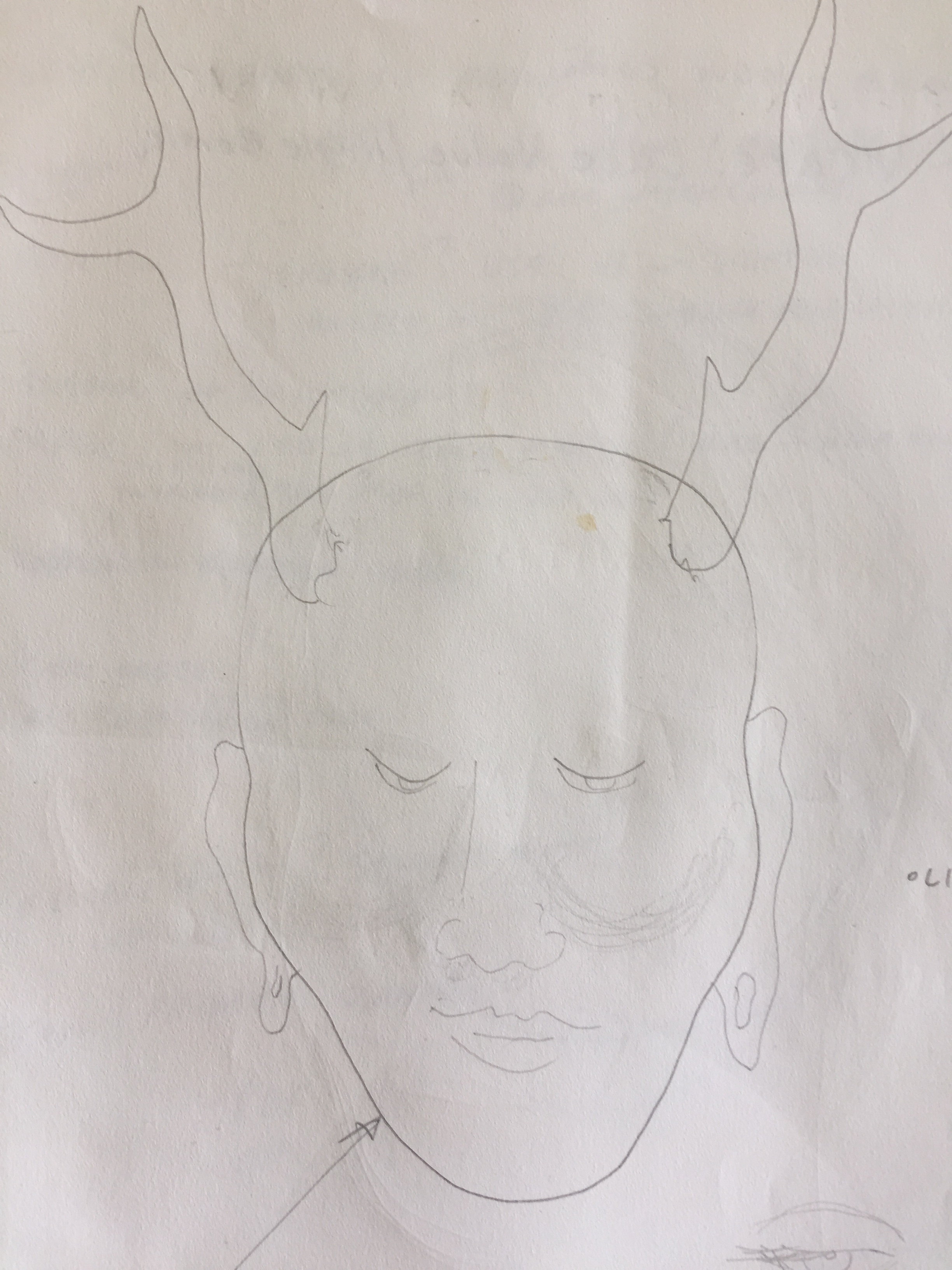
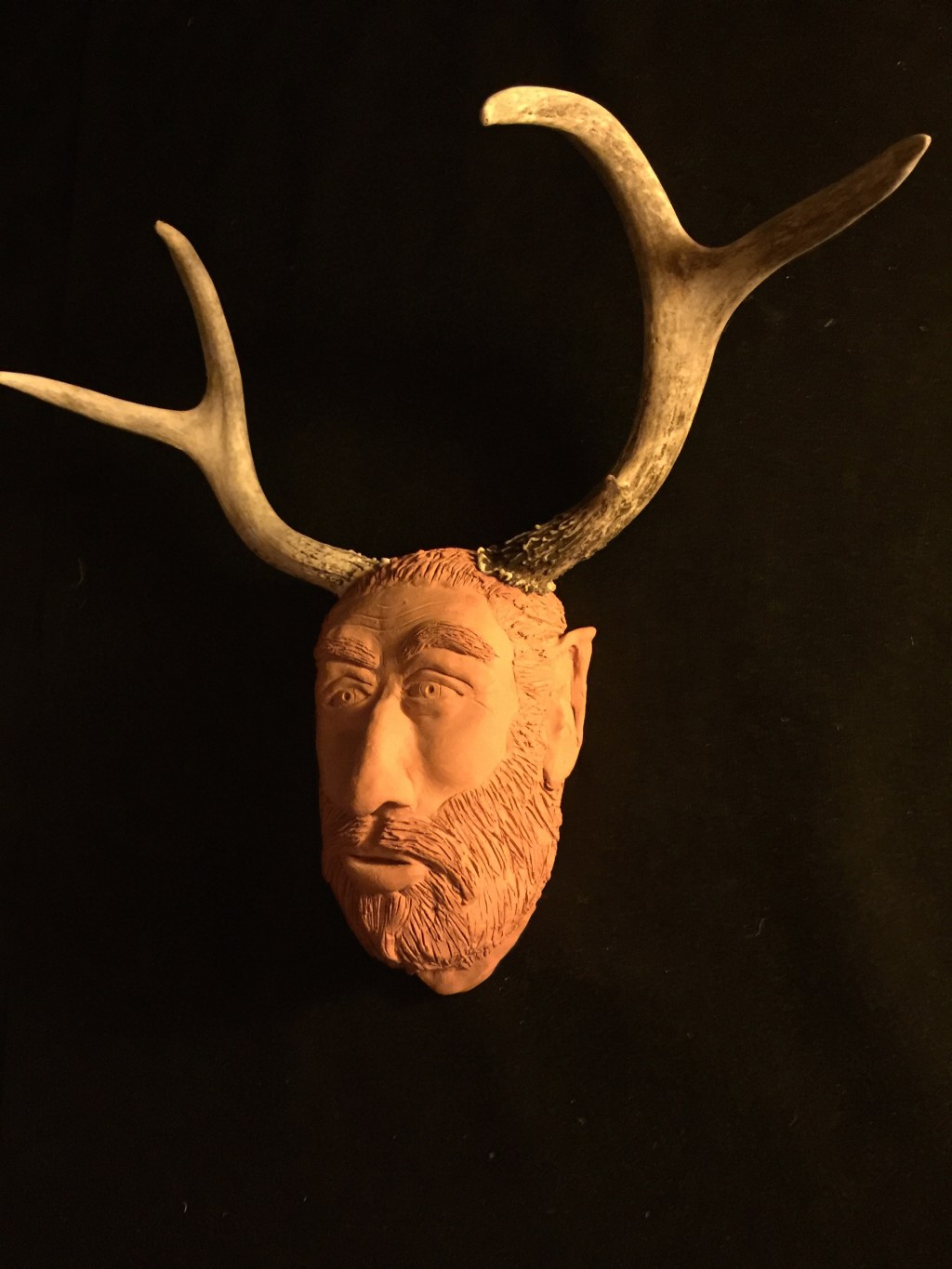
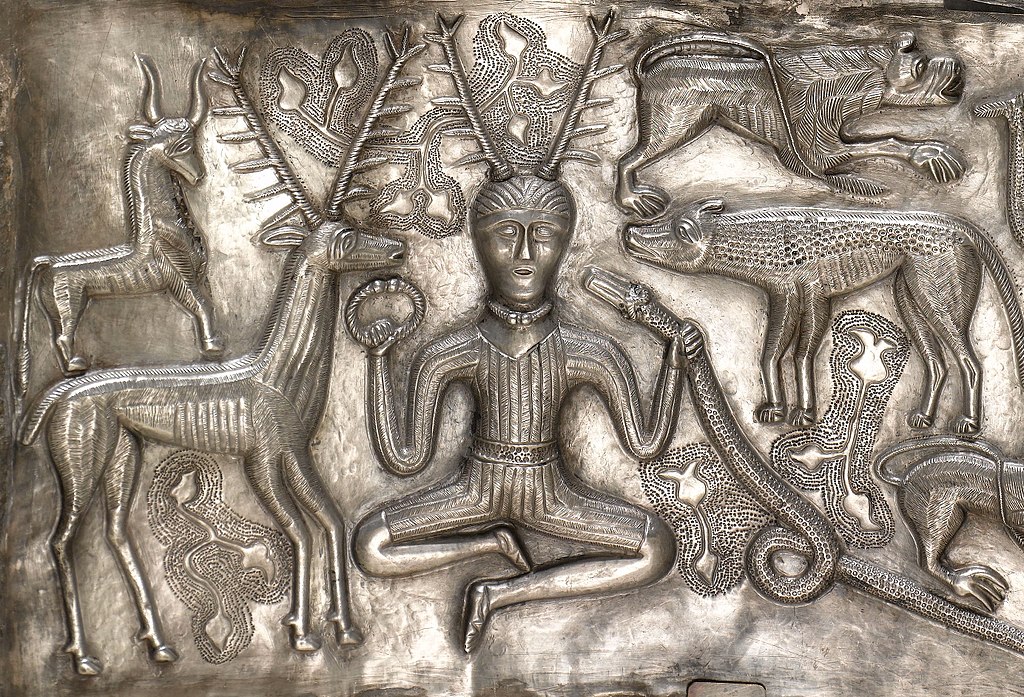
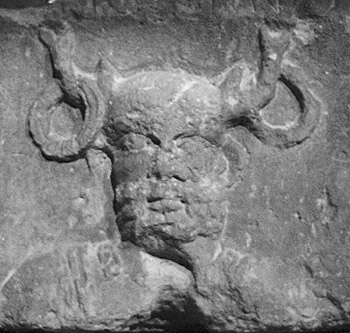
There are not many depictions of Cernunnos and he is only referred to once by name  (on the Pillar of the Boatmen above). The top engraving is from the Gundestrop Cauldron. Unlike Pan and Faunus, which are horned, Cernunnos is an antlered deity. Without much to go by, I sketched this first image:
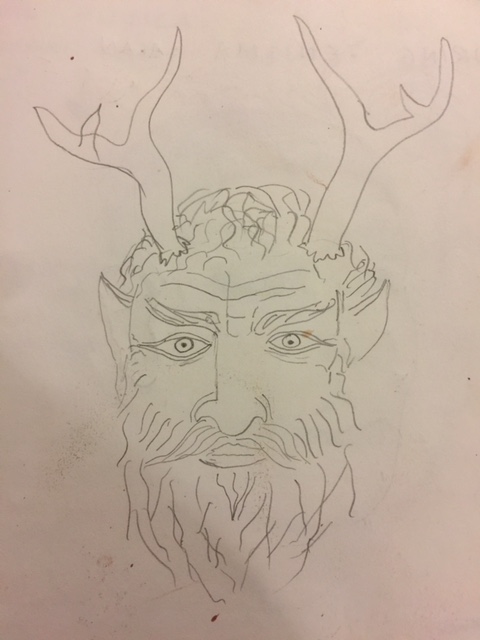
image

Which gave me a rough guide to start working on my mask.
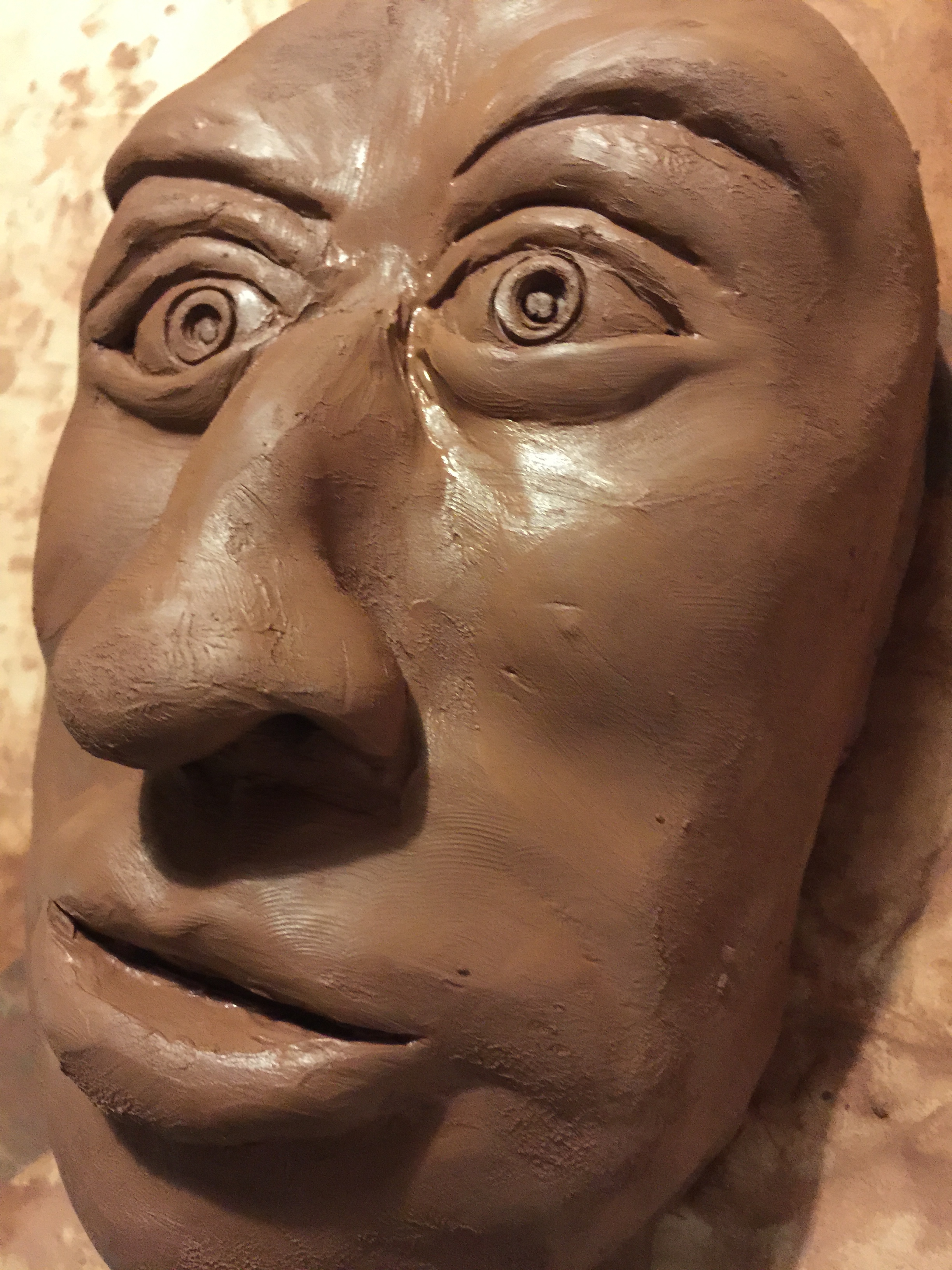
image

Which, after some refinements and detailing……
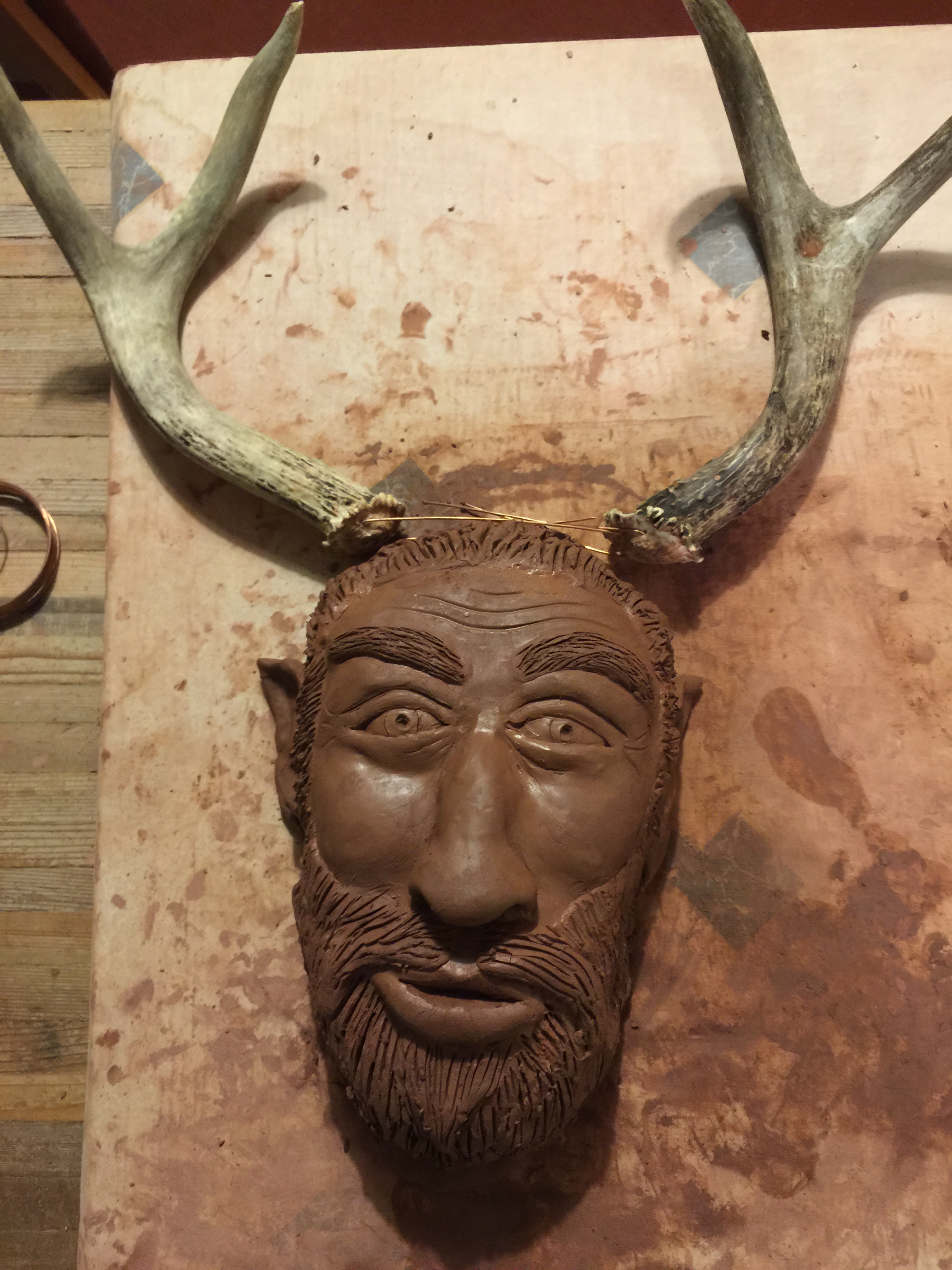
image

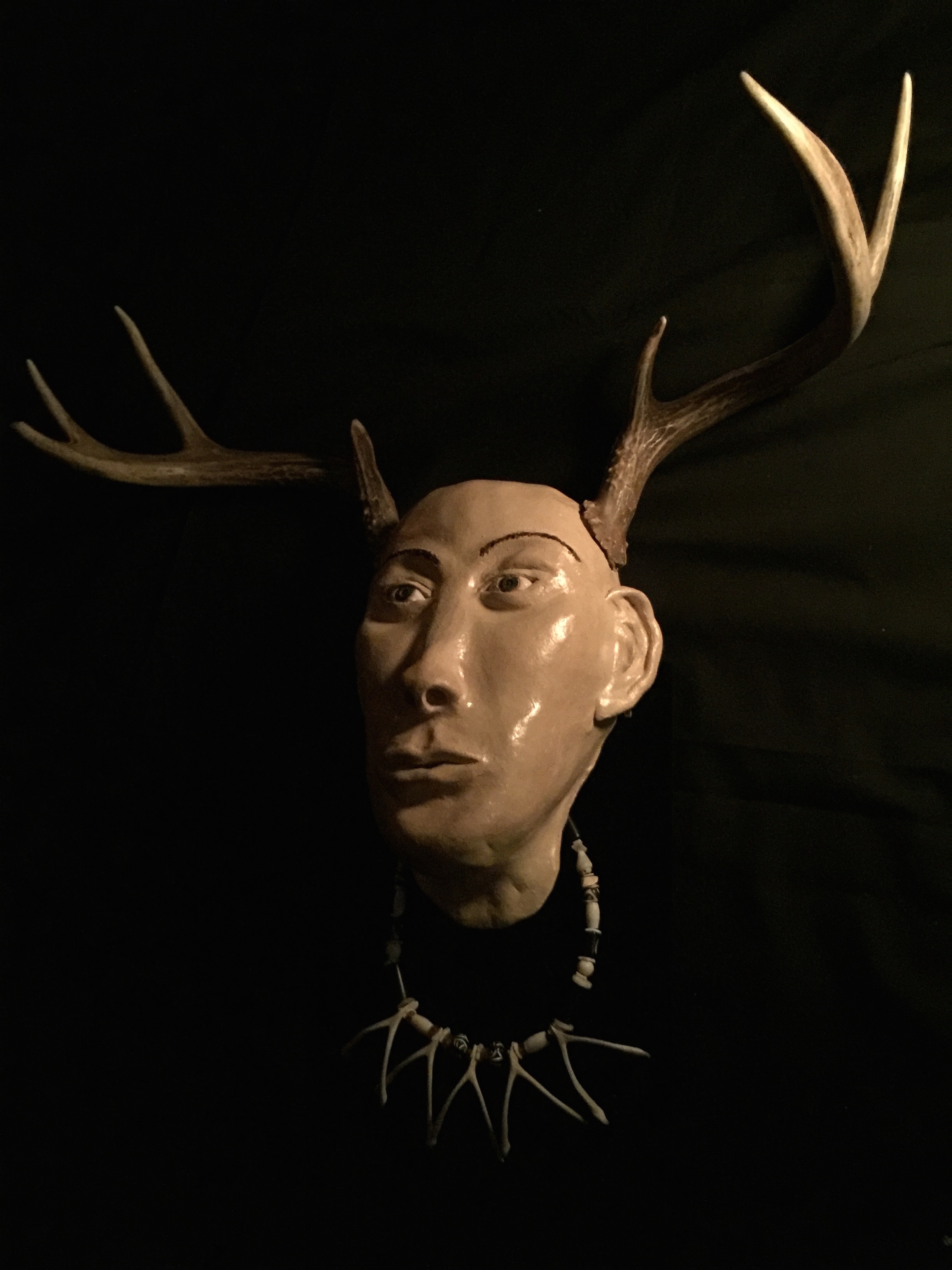
And some kiln time, produced the final product which you’ll see below…
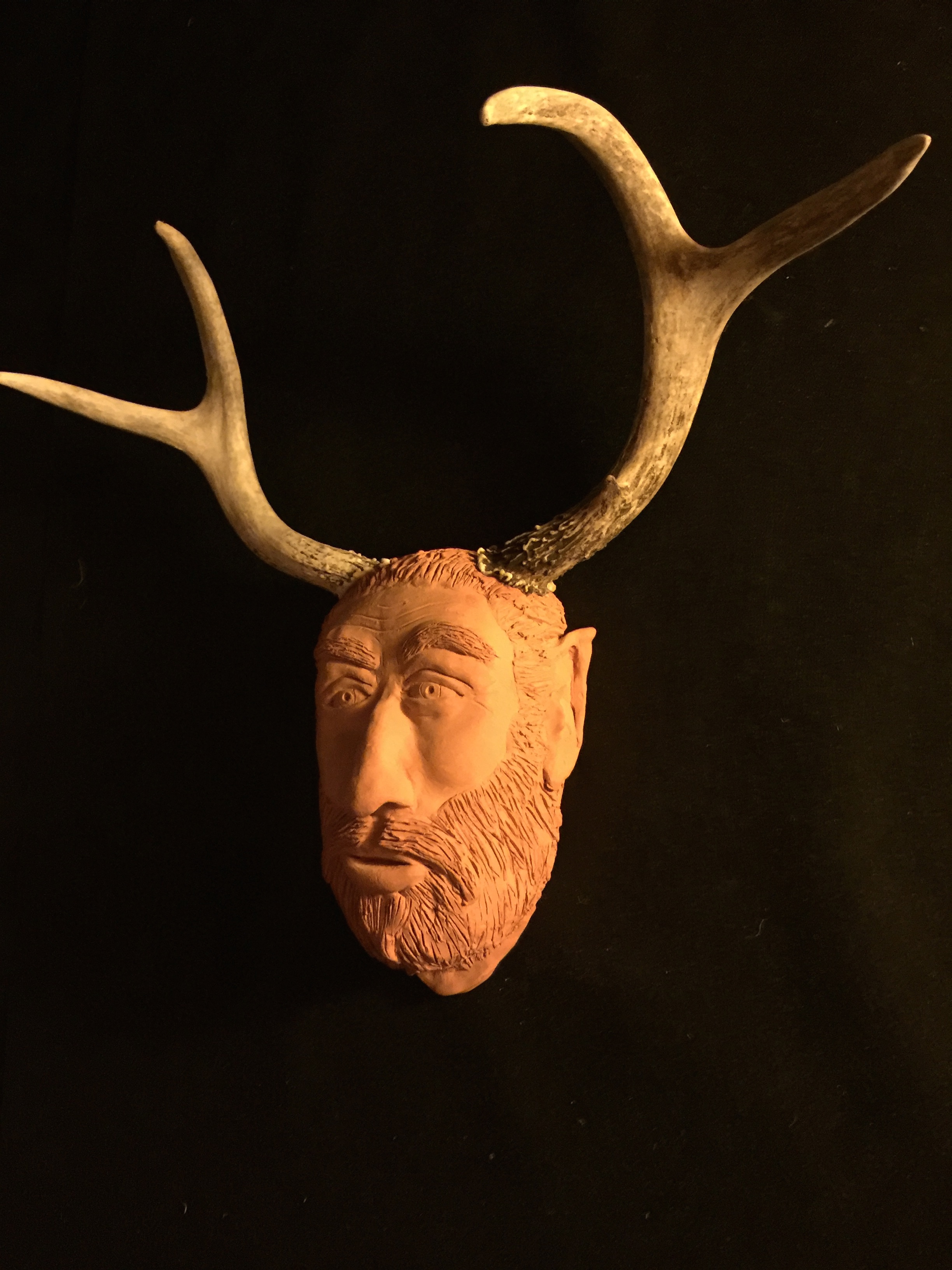
image

My original intent was to leave Cernunnos unpainted so it could weather the elements and be displayed outdoors – in nature  – where Gods of Nature would most likely prefer to reside. I subsequently had an urge to paint this mask, which I did, but have not yet had a chance to take photos. This I will do upon my return to Mayne Island from Mexico sometime in March. Hasta Luego!

The Oppenheimer Mask

It’s mid April of 2014 and I am busy with my little studio café and the chores of spring in a rural environment. As the weather improves, so does attendance at the café and I am also finding myself increasingly outdoors to attend to my flower beds and vegetable gardens in anticipation of this year’s plantings. My studio has not yet evolved into a Gallery and the café offerings are still quite minimal – a decent selection of tea and a daily coffee. Cookies have not yet arrived but I am in the process of “testing the wares” of local foodie/baker Astrid to choose a small selection of goodies for locals to nibble on with their teas and coffees – ostensibly while I would be working on creative projects.

As I was discovering, the dream of running a little self-serve Café Gallery while I worked – undisturbed – on my art and writing projects was not reflected in reality. Even in the slower early days of this new project, my gregarious nature and the islanders willingness to sit and chat meant that much creative time was spent in conversation. Despite this, chores were still being done, projects were initiated and completed, and masks were being made, albeit on much more chill, “island time”.

The Oppenheimer Mask would be my first attempt at creating an image of a recognizable historical figure. Because of this, it makes the explanation of “Why Oppenheimer?” a little more complex. Robert Oppenheimer was considered – by some – to be the father of the atomic bomb for his role in the Manhattan Project , the WW2 undertaking to develop the first nuclear weapons used in the atomic bombings of Hiroshima and Nagasaki. Despite the singular significance of his contribution to the origins and development of Weapons of Mass Destruction, Oppenheimer was ultimately conflicted about proliferation, the advent of more powerful weapons and their politicization. He has also been seen as “symbolizing the dilemmas involving the moral responsibility of the scientist in the nuclear world.” When I first saw Oppenheimer in the attached grainy black and white TV interview, I was struck by the obvious struggle taking place within him as he brushes away tears and quotes from the Bhagavad Gita…”Now I am become Death, the destroyer of worlds”…it is 1965, a full 20 years after the explosion of the first nuclear weapon at Alamogordo New Mexico where Oppenheimer worked.

The world is – at this time – immersed in the Cold War and a nuclear arms race whose gift to us is of Mutually Assured Destruction. Oppenheimer’s pain is palpable as he reveals his emotional state to us in this interview. The burden of realization…of a deep glimpse into uncertain futures, and his contribution to this morass is etched in his face.

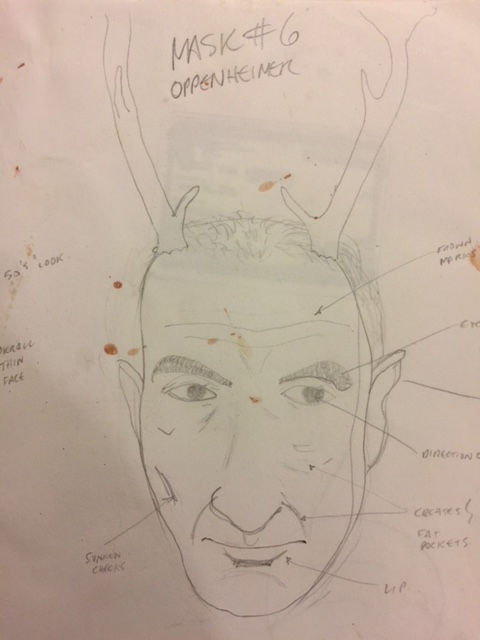
From a purely artistic point of view – I also found his face interesting and wanted to tackle it’s creation as my next project. As is usually the case, this starts with a sketch:

IMG_2354

It is April 25, 2014 – I cleared a space in my studio, assembled my clay and utensils and began to construct Mask # 6 – it is also my 2-year sobriety anniversary – so much has changed, for which I am so grateful.

IMG_0545


It normally takes me the better part of a weekend to create a mask. As Oppenheimer was more detailed and complex than some of my previous images this extended to 3 or 4 days. This does not include the week (or so) of drying/curing, the subsequent firing, and eventual glazing or painting.

This would be the first time that I would use Fallow Deer antlers on a mask. Mayne Island has a bothersome surplus of Fallow Deer. They are an invasive species which are damaging the local ecosystem (and, of course, gorging on islanders petunias) – and are consequently fair game for local hunters. The Fallow Rack is a more dramatic antler display than the indigenous Black-Tail Deer and resembles Reindeer antlers – which are also related to Elk. Here is the finished mask:

fullsizeoutput_113b

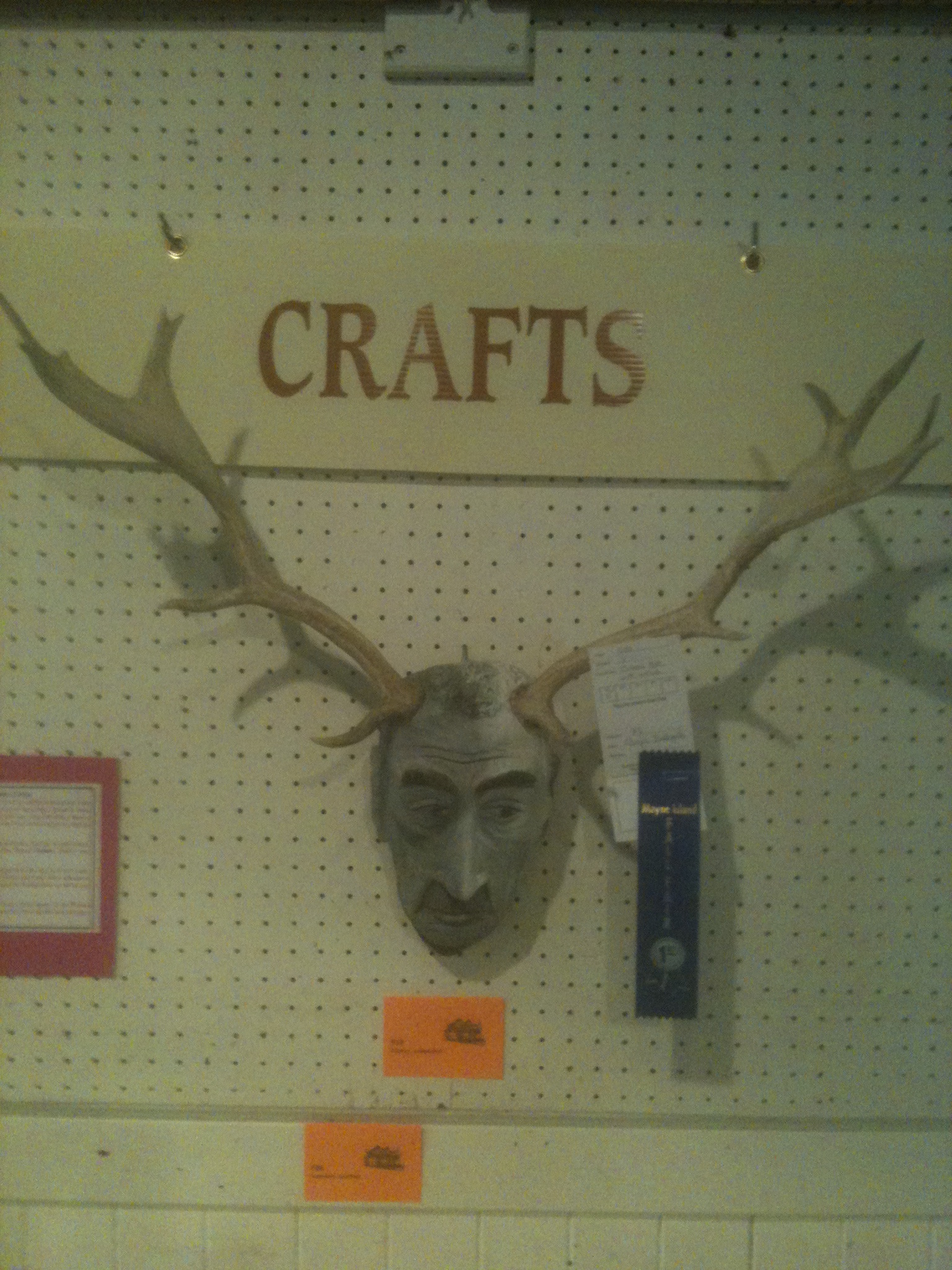
Postscript: The story, dear reader, does not end there. I am happy to tell you that I was the proud recipient of a Blue Ribbon award at the 2014 Mayne Island Fall Fair – a not-to-be-missed event if you ever happen to be on Mayne Island in the Middle of August 🙂

IMG_0603

Sakura – Asian Woman Red

January on Mayne island is tranquil, some might say slow, while others still might find it boring, decrying the relative lack of urban distractions or warm summertime activities. The full time population of roughly 1,000 – which can swell to 2500+ in the busy summer season – likely drops to 7 or 8 hundred as sun seekers migrate to points south.

It’s mid-January 2014 and I am not bored. Each weekend as I commute from Vancouver to Mayne I have a myriad of engaging tasks and creative activities to keep my mind active and my body moving. At this point – just 2 months into the setting up of my studio Shavasana – I am: working on some signage projects; putting together a business Facebook page; planning some gardening in a few beds I’ve created and a 6′ x 12′ raised vegetable garden that I’ve inherited; in discussions to co-manage a Yoga retreat; searching for new “Antlers for Art”; meeting a flurry of residents of this bucolic sanctuary, and making some art – in the form of necklaces and masks.

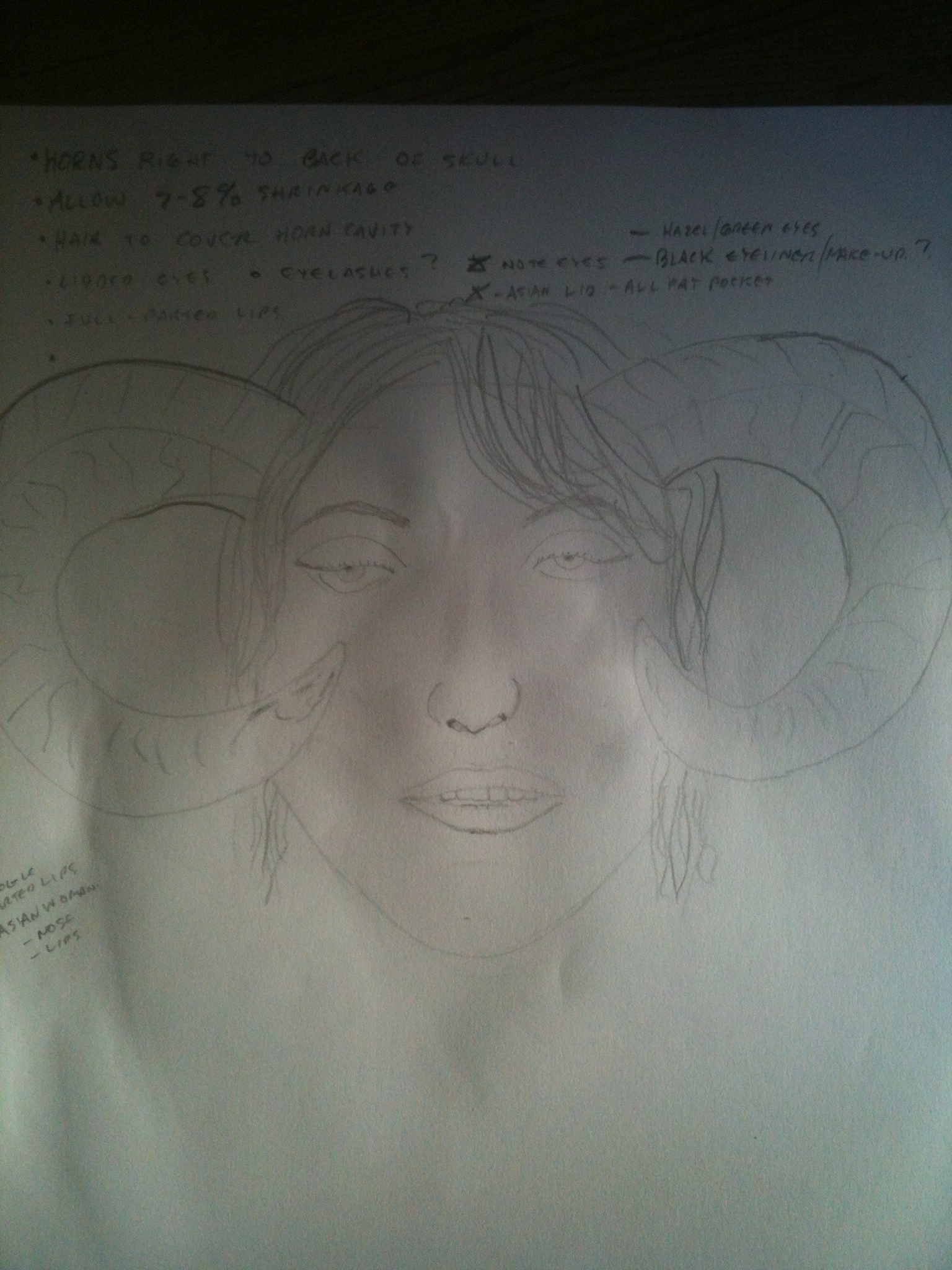
I had just completed mask # 4 –  Chaac – in early January and was now researching imagery and sketching possible faces for the elusive Asian Woman Red which would become Mask # 5. Asian Woman Red came with some new technical challenges. Unlike previous masks, which were adorned with deer antlers, AWR was being given the distinction of sporting Bighorn Sheep Horns*. Due to their size and hollow nature, and the fact that I use glue sparingly, made attaching the horns to Asian Woman Red  fullsizeoutput_13

especially challenging. My preferred method of attaching antlers involves drilling a hole at the base of each antler, running a thin copper wire through the hole and affixing it to the mask via holes in the skull which are then “tied off” inside the mask cavity. As this was not possible with the Horns, I wound up affixing wooden blocks within the hollow horns, drilling two holes in each and then running the copper wires through the blocks and into the skull to provide more stability. Here’s a little video illustrating day one of working the clay and a look at the big horn mask attachments:

Here is another video showing the final look of Asian Woman Red before curing and firing. You’ll note that the clay is still moist and a few touch ups are needed – but the hoped for outcome is close.

It’s always necessary to let the mask cure for a week or two to ensure that there is no moisture left in the clay when it goes into the kiln. This can lead to the mask exploding upon firing, a lesson I learned the hard way in the early days of my mask enthusiasm (see: Mask Making – Abraham Maslowe’s Exploding Head ) . Once I feel confident that the mask is dry and that no cracks have formed in the clay which need repair, I take the mask to my friend John who runs a little business in Kitsilano called You Paint, I Fire . It is here that I will have AWR fired, as I have done for all masks thus far with the exception of Tuatha. John is a very congenial fellow and it’s always a pleasure working with him on my creations. There is always a danger that some undetected inconsistency in the clay will lead to “mask failure”…some irreparable disaster that ruins all of one’s efforts. Thus far, with John at the helm, I’ve been fortunate.

Asian Woman Red came out beautifully – unscathed from her trial by fire. I stuffed her into my backpack for the foot passenger journey back to Mayne Island where the horns awaited attachment and my paints were ready for the final adornment of the “vision” (since Chaac I have chosen to paint my masks as I feel it gives me greater control over the colouration and final outcome)

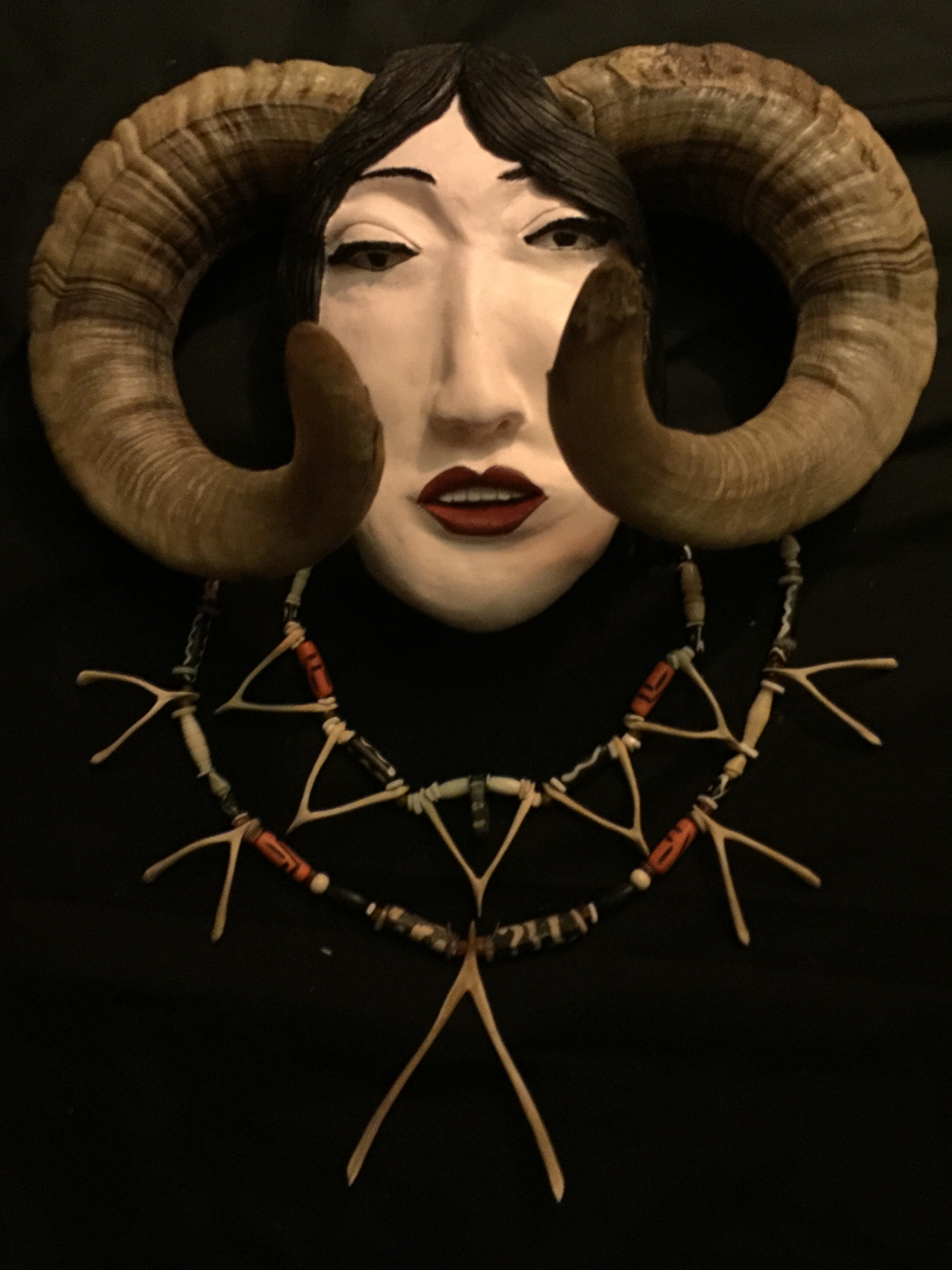
Over several months as I pondered this new member of my studio, I found myself drawn to Geisha imagery for colouration – specifically the light rose pancake makeup that they wear. Also the name Sakura – which means Cherry Blossom in Japanese – seemed to dovetail nicely with the evolving look of Mask # 5. I’ve always had a soft spot for Japanese culture having grown up in a family that counted many Japanese families among our dearest friends. I also learned how to sing a traditional Japanese song called, “Sakura, Sakura” in grade school, which I can belt out to this day 🙂

Sakura’s look is a little mysterious and sensual, she gazes at you through her heavily lidded eyes down her elongated nose. The Horns are symbols of strength and power which would dissuade all but the most ardent to attempt a kiss of her red passionate lips…here is the final image, adorned with some of my more delicate wishbone necklaces

IMG_1113


*I am not a hunter. All of my antlers and horns have been donated or – in rare instances – purchased. The Big Horn sheep horns were owned by my ex-wife and I received them from my son when she passed away in 2013…I don’t know if the sheep was hunted or died from natural causes. The horns are branded with the number: M6

Chaac – Life of It’s Own

It’s Friday January 10, 2014 and I am beginning to work on Mask #4. This will be my second effort at creating a female image. Perhaps my will to do so was not as strong as the will of the clay to come forth as a male, but #4 was decidedly not feminine right from its inception. Perhaps this also reflected my skill level at the time, or that many diverse images were floating through my consciousness, and that there was no great rush to prevent #4 from being born with whatever visage the clay offered up. I didn’t fight it, it seemed to have a life of it’s own. As it took shape it became quite apparent that this mask was not going to become the elusive “Asian Woman Red” that I had first sought when I was creating Mask #3 – Rinpoche.

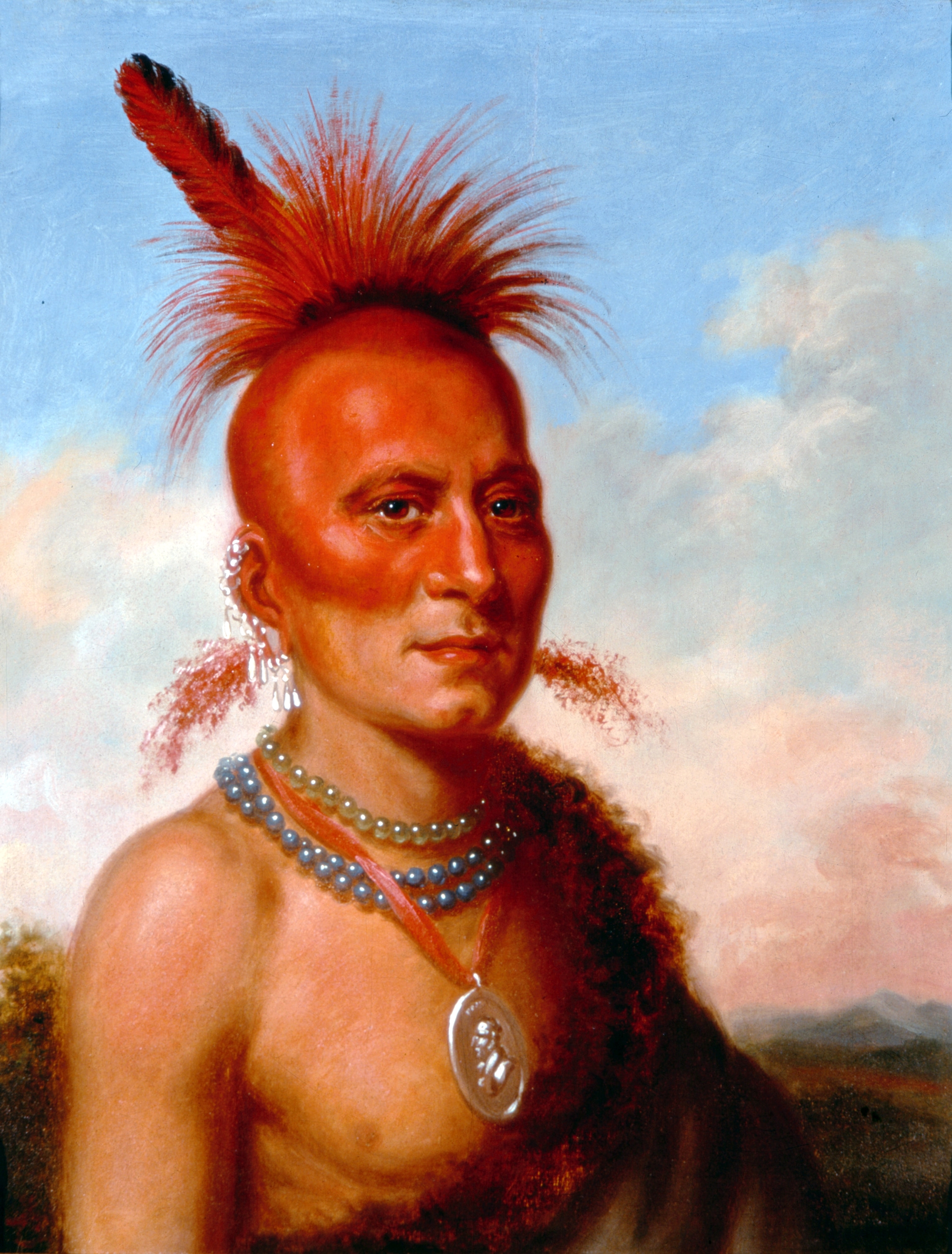
One of the many mask images that I wanted to create can be loosely defined as “North and/or Central American indigenous male”. I had a general preconception of such a face as I was hoping to effect, and also spent a considerable amount of time researching and reviewing imagery which is now so plentiful online. It’s all there, and I eventually found myself drawn to Huron and Mayan faces.

With a mind to glazing and coloration of the final “look”, I was drawn to the repeated use of red face paint that I found online – primarily the upper part of the face with additional details in either white or black. This usage doesn’t appear to cross the border into Mayan territory, where facial adornment has a completely different cultural style and meaning.

It wasn’t until after Mask #4 came out of the Kiln and was fired, glazed & painted that the Mayan name Chaac returned to me from deep memory. As one who had been exposed to global culture since childhood – by way of National Geographic magazine, the pre-Columbian Mesoamerican statue of a Chacmool had resided within me for some time and was now finding a way to enter my creative space as a name for one of my masks. Although the Chacmool, “symbolised slain warriors carrying offerings to the gods”, the name “Chaac” refers specifically the the Mayan rain deity, who:

“Like other Maya gods, Chaac is both one and manifold. Four Chaacs are based in the cardinal directions and wear the directional colors. In 16th-century Yucatán, the directional Chaac of the east was called Chac Xib Chaac ‘Red Man Chaac’,”…Here is the final outcome of Red Man Chaac with antlers, and adorned with one of my necklaces.

Sold

Rinpoche

It is late November 2013 and I am ensconced in my new studio on Mayne Island.  Daylight Savings has kicked in so the days are short and becoming cool. November is “shoulder season” in the Gulf Islands, the tourists have gone home, weekenders and part-timers and other fair weather friends have vacated, the locals are winterizing their cabins and the peak summertime population has plummeted by 60%. It is slow, and I am soaking up the tranquility and feeling of decompression that I get each Thursday when I arrive by ferry from Vancouver to open up my studio.

My “business model” was still quite loose and embryonic – studio space for some of my art and writing projects, a little additional art on the walls from various sources, and a self-serve coffee and tea bar with tables where people could hang out with a drink, use the wifi and chillout. I’d been open to the public for a few weeks, slowly getting to know some of the braver souls who were curious about my new space, and filling my spare time with creative projects.

During these early days of opening up the studio/gallery/café my hours were filled with a myriad of engaging business oriented tasks, and I was also starting to turn my attention to the backlog of art projects that lay before me.  I had a considerable amount of material for a series of paganistic necklaces which I wanted to produce, and was beginning to sketch images for my next series of masks. My first inspiration after this 2 or 3 year mask-making hiatus was “Asian Woman Red”…I began researching and sketching femalefaces of asian descent with a mind to coating the finished product with a red glaze. Early sketches of Aung San Suu Kyi’s face morphed into a Female Wood Nymph… fullsizeoutput_14bb

and then ultimately the delicate and wise Tibetan Monk – Rinpoche – which mask # 3 became.

IMG_2190

Although this return to mask making at my new studio did not immediately give me “Asian Woman Red” I was happy with the result as my hands gave birth to this new mask I would call Rinpoche, (which “is an honorific term used in the Tibetan language. It literally means “precious one”, and may be used to refer to a person, place, or thing–like the words “gem” or “jewel” (Sanskrit Ratna).”)

Here are some pictures of the early, pre-firing process:

fullsizeoutput_95

fullsizeoutput_37

I find that during the mask making process the clay can have a life and direction of it’s own and will provide characteristics which were not necessarily intended at the outset (perhaps this is a function of my skill set :), Rinpoche has arrived and his features and demeanour do not call for a red glaze – Asian Woman Red will come later – here are some pictures of Rinpoche as he looks today:

fullsizeoutput_113e

fullsizeoutput_1143


Boko – The Influence of Events

(This is another instalment in the retrospective I’m doing for this website on the 10 masks I have – thus far – created)

It is 2010 or 2011 and I have moved – twice – since creating Túatha, the prototype for my series of masks adorned with antlers. Five years have elapsed and I am now living in a house in Kitsilano. Much has transpired since Tùatha was conceived (https://clayandbone.com/2016/12/13/death-mask-troubled-dreams-on-the-road-to-clay-bone/ )…and I feel the stirrings of the Muse. I’m still heavily engaged in the drinking process and have set up a “man cave” in the garage on our property. I’ve recently rediscovered the second set of antlers which I purchased at the same time as those which adorn Tùatha and have found – much to my surprise and delight – some remaining clay which was quite readily resurrected with a little bit of work and water. The man cave would serve as my studio where I would create my next mask based on the attached image of a shaman from Togo in a voodooistic trance.

Image result for african shaman with white eyes picture

Admittedly, this mask, with it’s white eyes and indeterminate expression has a slightly malevolent look. To me it seemed perfectly suited for the set of antlers which I had in my possession, and I was determined to depict it in clay.

As is true of all of my masks since Boko, I begin the process by creating one or several rough sketches of the subject. I find that this gives me a better feel for the shapes and contours that I will be trying to recreate, and gets me in touch with how the antlers will best be situated. It also allows me to create a larger image from which to work, and provides a copy that I don’t mind getting wet or stained during the messy mask-making process.


For the first several years of its life Mask #2 (as Boko was first known) remained nameless and unadorned. It began as a fairly simple reintroduction to the mask making process after a 5 year hiatus. I applied a dark brown glaze to try and match the skin tone in the picture, attached the antlers and let it sit until I opened my studio on Mayne Island, several years later. While on Mayne, I had a chance to reflect on this mask and had been influenced by events in northeastern Nigeria, where an islamist/extremist group named Boko Haram had been committing atrocities. I named him Boko – after the group – as a tacit recognition of the evil which can reside in all of us.

The picture to the right (above) was created on Mayne Island as I searched for ways to bring more human detail and life to Boko. The three face depictions have different examples of sub-saharan face paint that I gleaned from online research. I ultimately settled on a variation of the face paint example on the bottom left which is from the Wodaabe tribe – a small subgroup of ethnic Fulani nomadic herders in the Sahel. The variations of brown paint shown above were used to give more character and detail to the original glazed mask – especially to highlight Boko’s lips.  The final result can be seen here:


Mask Making – Uluru…Dreamtime

I grew up in a National Geographic household. For as far back as I can recall, my parents subscribed to NatGeo, and it was always a moment of anticipatory joy when the plain brown-paper envelope arrived in the mail with each months issue. As a kid, it was all about the visuals. Archaeology, anthropology, astronomy…nature & culture…exotic people, places and events all brought to you in glorious illustrations and photographs. I think I can credit National Geographic for strongly influencing my worldview, and broadening my outlook immeasurably. It offered a technicolour glimpse of a – then – black and white world.

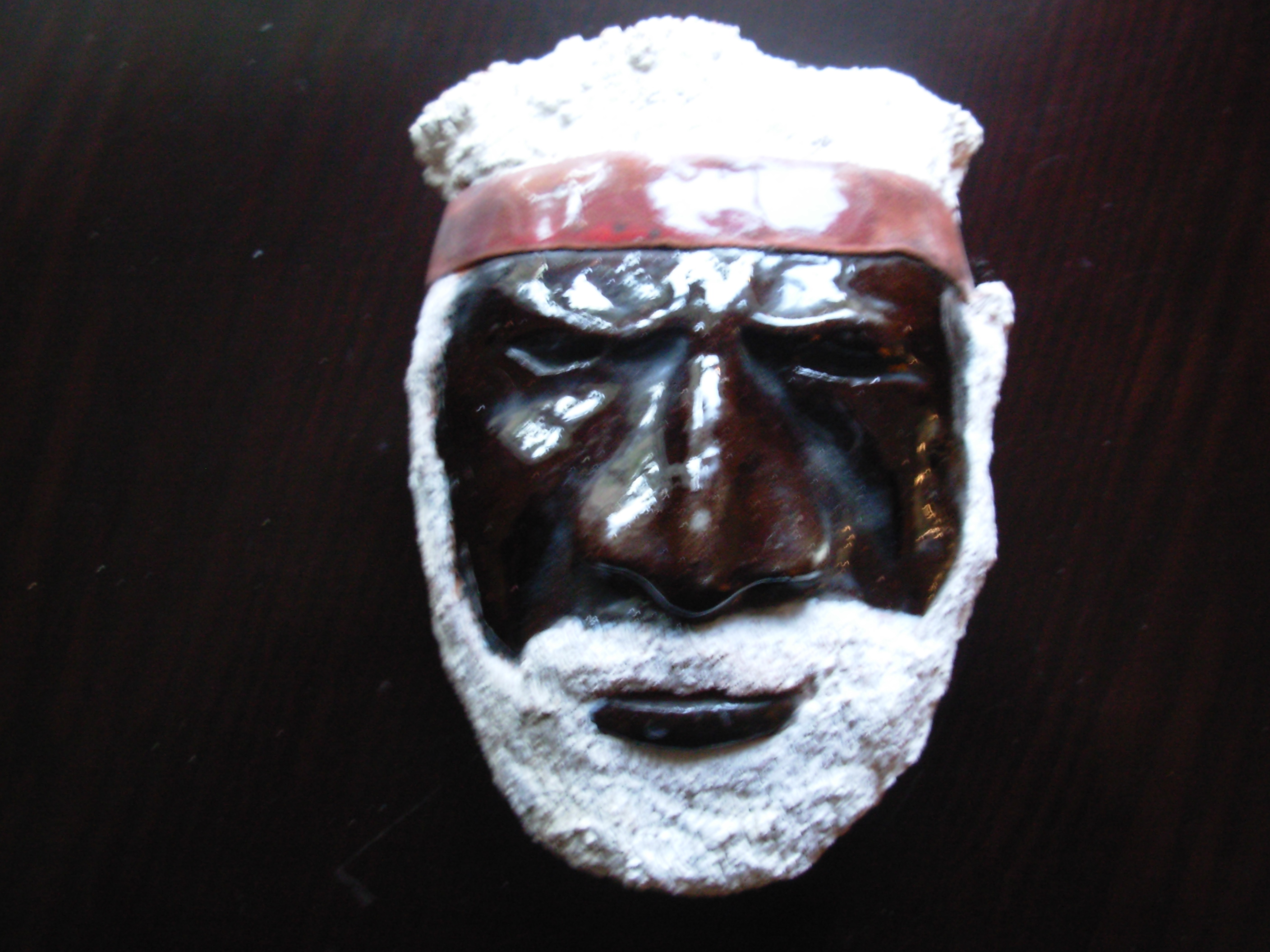
This is a photo of the first mask I ever made. I created this in high school, and the image was borrowed directly from one of our National Geographics. The face is of an aboriginal


DSCN1318Australian man, and I recall being fascinated with his weathered, sun-baked face. This mask remained unnamed for many years until the Australian government began a policy of renaming prominent landmarks and locations with indigenous names. Uluru is the name given to the former “Ayers Rock” , and is sacred to the Pitjantjatjara Anangu people of the area.
Dreamtime refers to a religio-cultural worldview attributed to Australian Aboriginal beliefs which goes way way back into the distant past, back to a “time out of time” or an “everywhen” that has been long forgotten…it’s very similar to me trying to remember what I did in high school…luckily, Uluru is there to remind me 🙂


Mask Making – Abraham Maslow’s Exploding Head

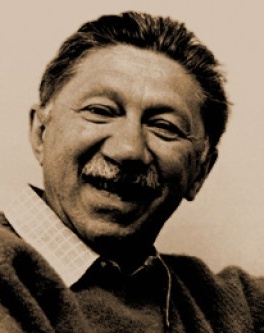
It’s 1976 and I am a new student at Simon Fraser University in Burnaby working towards my Bachelor of Arts degree. Like most first year students pursuing a liberal arts education, I enrolled in the obligatory “101 Courses” – Sociology 101, Philosophy 101, Political Science 101, and Psychology 101. These introductory courses give one a brief overview of each discipline – a glimpse of the significant ideas, and of the great minds and leaders that contributed so profoundly to each school of thought. Like many a young undergrad, I embraced certain great thinkers and their work with the enthusiasm of the newly-informed. Psych 101 introduced me to Abraham Maslow and his theory known as “Maslow’s Hierarchy of Needs” (https://en.wikipedia.org/wiki/Maslow%27s_hierarchy_of_needs ) …which I found stimulating and enlightening and caused me to faun over “all things Maslow” …for a while at least.

Abraham Maslow.jpg

With the fervor of an acolyte, I felt that I would show my deep admiration for my new Psych 101 Guru with the creation of a graven image in his honor – I would buy a big lump of clay and sculpt a ceramic likeness of him which I would put on my mantle for all to see…this would be my second attempt at mask/bust making since high school….and really, how could you not want to – just look at that face! 🙂

I went out and got my materials and set to work. Twenty pounds or so of grey, cold, wet clay which I would squish and pound and flatten, mold and sculpt into a reasonable likeness of my love object – Abraham Maslow ❤ Within days I had crafted a wonderful 3-dimensional bust of Dr. M. which I left it out to dry in the kitchen of the house I shared with friends in New Westminster.

But where to take if for firing? I didn’t have a kiln but I knew my good friend Doug W. shared one with his father as they were both into making ceramic plates and bowls on the potter’s wheel, which they also co-owned. “No problem”, said Doug, “Dad and I are firing a batch of new plates and bowls which we’ve just made – why don’t you stick your head in the kiln and we’ll fire it for you” …potter’s say such things 🙂 So I put Abraham under my arm and trudged off to Doug’s kiln place in Burnaby. All seemed in order…kiln full of lovely plates and bowls…glazed and ready to be baked. I gingerly placed dear Abraham Maslow in the oven…closed the door and turned up the heat.

I don’t recall how long the firing process was. Maybe we hung around and visited…played some guitar…maybe I tried to convert Doug with the newfound wisdom that I had garnered from my Psych 101 course. Perhaps I went home and came back later at the appointed hour when the contents of the kiln had cooled down enough that it could be opened safely. Whatever the timing, when we finally opened the kiln like expectant children on Christmas morning, there it was… Abraham Maslow’s exploded head lying in pieces and shards, inextricably fused into the molten glazing which adorned Doug & his Dad’s beautiful ceramic efforts…

We stood in silence looking at the debacle inside the kiln. Doug and his father were too polite to get angry or cast blame, but I knew that the fault lay with Maslow & Me – so, of course, I blamed Maslow…”Well Dougie,” I said ”it seems clear to me that once Maslow had secured his basic physiological needs, and that the needs of safety, love and esteem had been achieved his efforts at self-actualization and self transcendence proved too much for him”…”and his head just exploded”…”the heat of the kiln likely expanded a cranium already filled with large and important ideas and it just burst…happens all the time”…

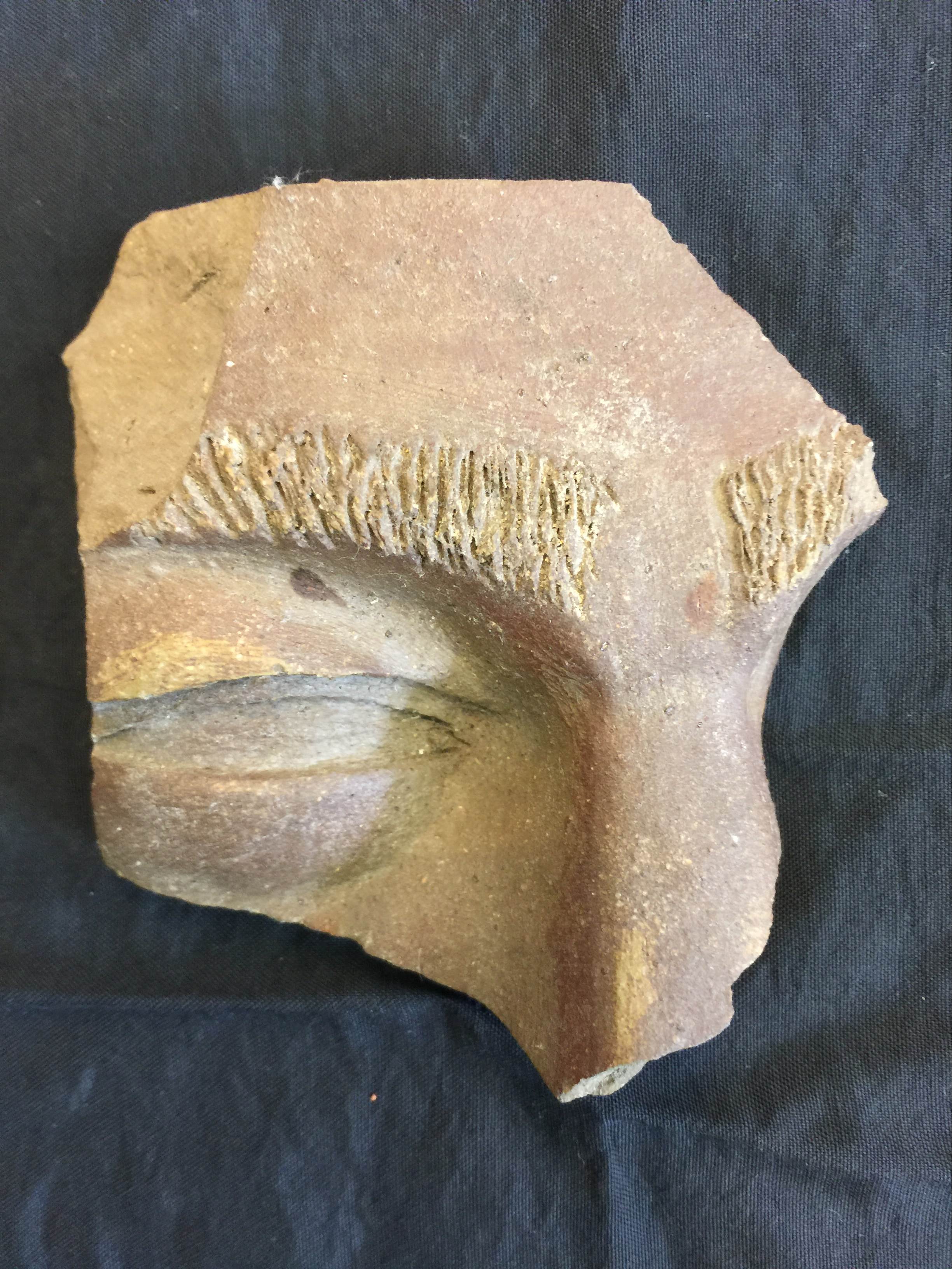
Doug and his father didn’t appear to be listening but were gingerly removing their pottery in hopes of salvaging some of their pieces. “Did you work & knead the clay before you started to sculpt your bust?”, asked Doug’s father, “it’s critical to do this to work out the air bubbles in the clay which can expand and explode during the firing process”… “Uuh…air bubbles?” I squeaked. “Uuh…yeah, I think so”…I peeked in and noticed that one of Maslow’s ears and the bridge of his nose were intact so I salvaged them as reminders of the “air bubble thing” if I ever delved into clay work again. Doug and his father kept one of the Maslow-splattered plates as a reminder to only share their kiln with ceramicists who actually knew what they were doing. Here’s one of the pieces of Maslow that I kept as a memento of my second attempt at mask making…

IMG_2101

Mask Making – Túatha the Prototype

The idea of creating human-likeness ceramic masks with deer antlers, (germinated the night of “The Seminal Moment” – https://clayandbone.com/2017/04/20/mask-making-the-seminal-moment/ ), didn’t evaporate with my morning-after hangover…like so many of my other ill-conceived ideas. The two pictures of Ben B. sporting makeshift branch antlers remained on my kitchen corkboard (Good Ben, Evil Ben) and served as constant reminders of the events of that evening. As it had been many years since my last mask-making attempt (which ended in tragi-comic disaster: https://clayandbone.com/2017/04/30/mask-making-abraham-maslows-exploding-head/  ) I thought it best to enroll in a clay-sculpting course, and found one being offered at Delbrook Community Centre in North Vancouver, taught by “Louisa”. Obtaining the appropriate clay was as simple as dropping in to any one of the many art supply stores in this town. But where does one find antlers? Mr. Internet was a great help, as was Steve Kulash Taxidermy (located then) on Kingsway in Burnaby. I bought 3 sets of deer antlers, of varying shapes and sizes, to help visualize and conceptualize the final product.

I studied sculpting techniques and researched various facial types to get the particular look I was after…sketching, copying or cutting out imagery from rare Library books (kidding!) I also expanded my understanding of the mythical pagan-era deities which sported horns and antlers – the Celtic Cernunnos (antlers), Greek Pan (horns), and the Roman Faunus (horns). It is interesting to note that these pagan deities, which primarily represented benign Gods of nature, forest, stream and fertility, had their imagery hijacked sometime during the Christian era when horned beings came to represent evil, or, the Devil. I’m not sure if this was a conscious and purposeful effort on the part of the church to blacken the benevolent reputation of these pagan deities, if so, it was a cynical reworking of history and a manipulation of indigenous beliefs.

Initially – on the first series of masks – I was trying to avoid the use of powerful glues to affix the antlers to the fired ceramic clay. To accomplish this, I designed a method by which I could: drill a small hole at the base of each antler; run a length of bendable copper wire through the hole; and run the wire through holes in the skull which were then twisted together, out of sight within the cavity of the mask. This left the antlers sometimes a tad wiggly, but I preferred this to the use of inorganic materials (granted, the final glazes and paints are not organic)

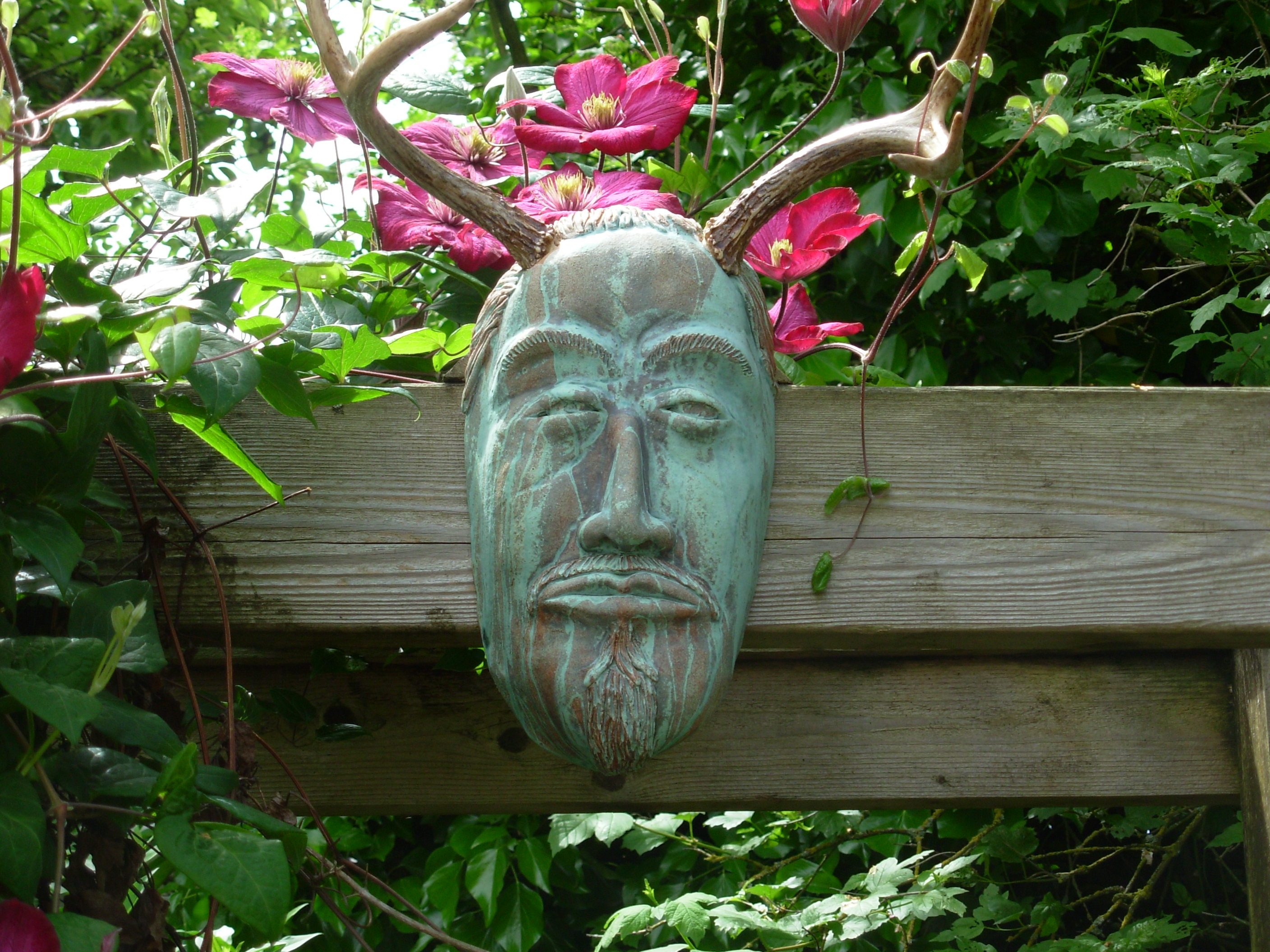
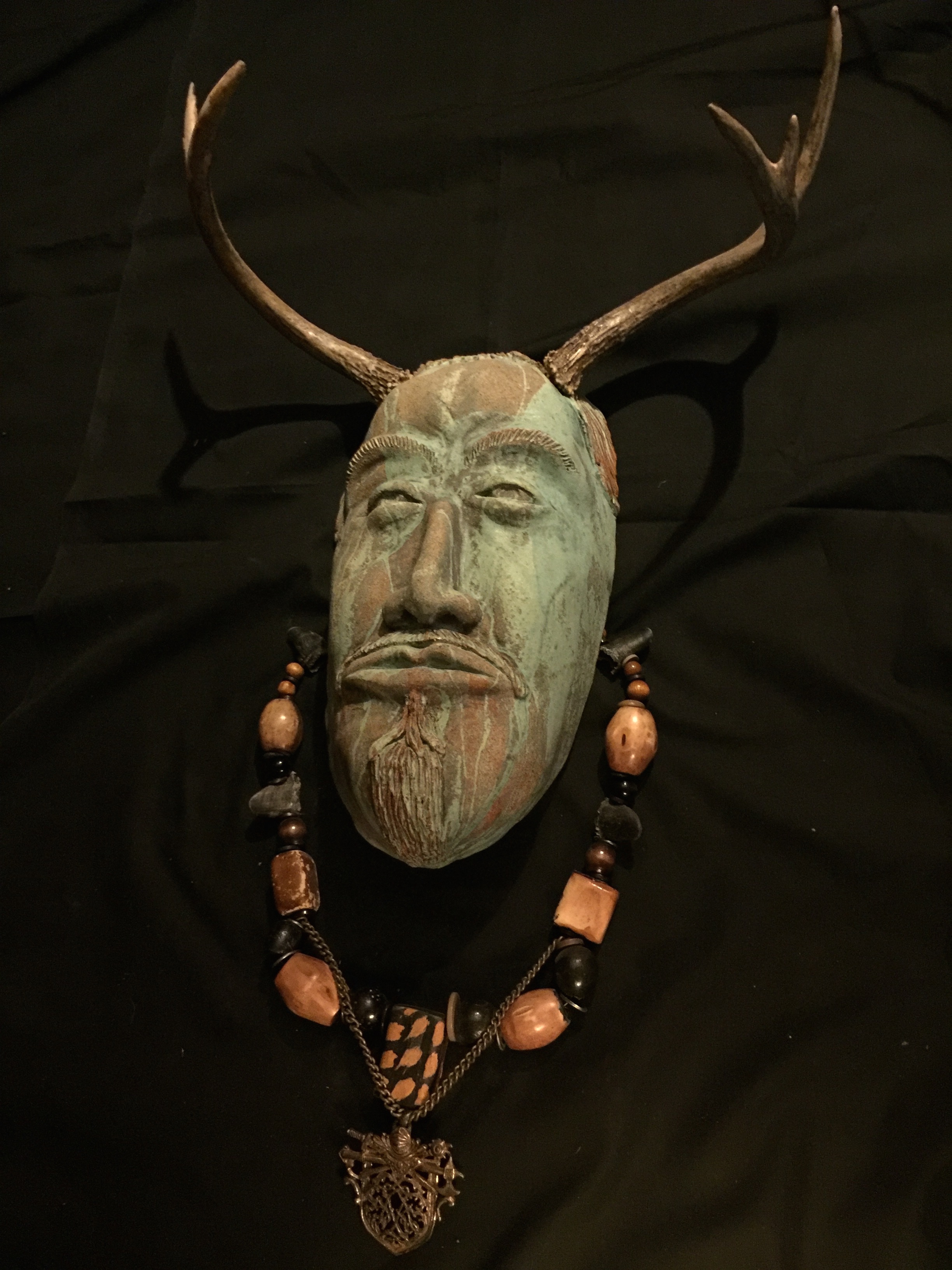
Some have noted that Túatha’s image bears a resemblance to me. Although that was not my intent, I too have found the visage to share Celtic/Nordic features (my heritage) which, when combined with the copper-rust patina, reminds me of a primitive time-worn relic of some forgotten Celtic King…It was this interpretation that inspired me to call the piece – Túatha – which is Gaelic (a subset of Celtic) for polity, people, or nation.

IMG_1107

(This mask is available for purchase:  https://clayandbone.com/portfolio/tuatha/ )

The whole process from concept to design and finally creation was fun and interesting and I was pleased with the final product. As a prototype, Túatha was a success, and my intention was to proceed with the next mask (see: “Boko – The Influence of Events” – article under construction). But it was 2005 and a disruptive piece of life had descended upon me ( see Death Mask Parts 1 and 2 – https://clayandbone.com/2016/12/13/death-mask-troubled-dreams-on-the-road-to-clay-bone/  )…I would not return to clay sculpting and the kiln for the next 5 years.

DSCN0300

Mask Making – The Seminal Moment

I would like to be able to say that my foray into mask making was born from a sophisticated artistic vision …perhaps a recognition of some cultural void that needed to be filled …maybe an epiphany which drove me relentlessly to bring my profound altruistic message to the world…sadly this was not the case. Although I cannot pinpoint the exact date upon which my moment of inspiration arrived, I do know exactly where it took place and what was going on at the time. The photographic record does not lie. I was on my back porch and I was stoned.

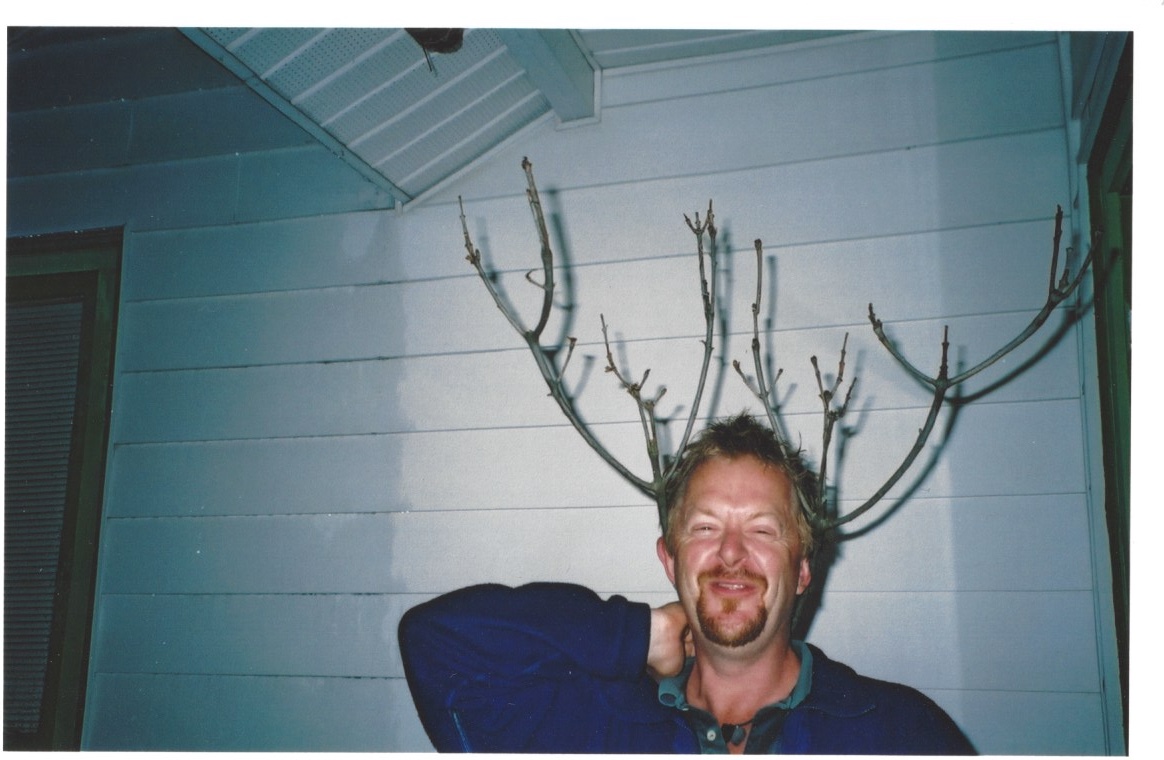
It was sometime in the early years of the new millennium – likely a summer evening judging by our clothes – I was at my home on 17th Avenue, in Vancouver, hanging out on my porch with my two deer friends, Craig and Ben, and we were stoned. Somewhere during our inebriated journey that evening I had picked up a tree branch which – in my mind – gave the appearance of deer antlers when affixed to one’s head. What jolly fun – a literal Stag Party. Taking turns acting out our archetypal Bucks…our inner Harts…

fullsizeoutput_13b8

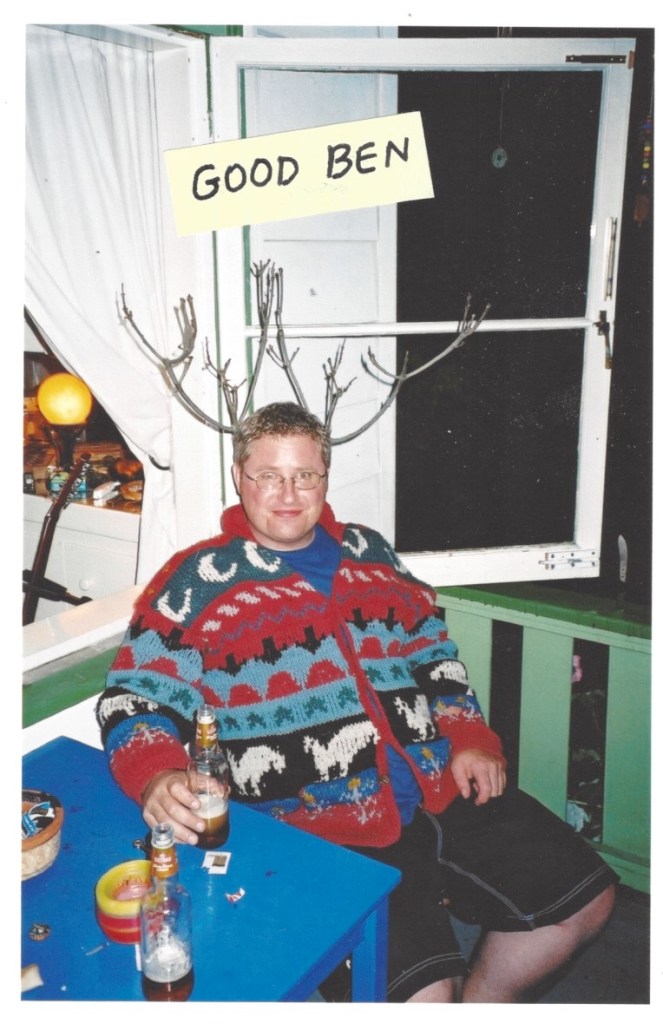
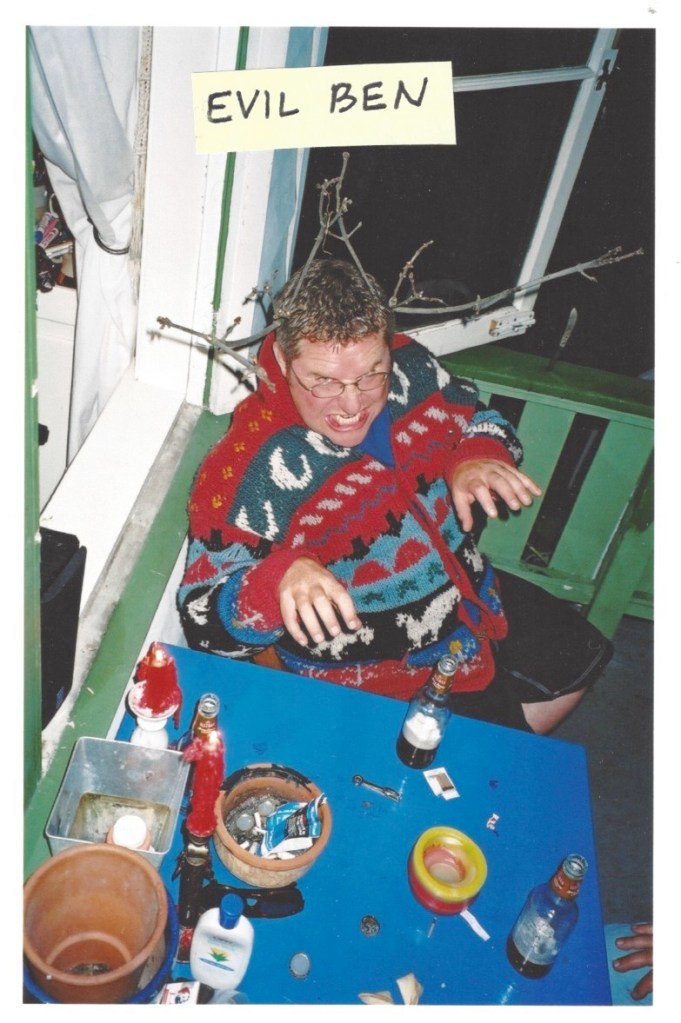
Ben decided – either of his own volition or through friendly goading – to give us two depictions of the Good/Evil archetype by grimacing and posturing during the second shot. I liked these two photos of Ben who was – in life – consummately good, and never evil…so I labeled them with tiny yellow stickies and stuck them on the corkboard in my kitchen for all to see. Good Ben, Evil Ben.

fullsizeoutput_13b6fullsizeoutput_13ba

The antics of that evening remained with me, and gave rise to further – sober or otherwise – thoughts. Could I fabricate a ceramic human-faced mask, and attach real deer antlers to it, and how might that be accomplished? I knew that antlers would not survive firing in the kiln so they would need to be attached after the firing/glazing process…how could they be affixed without falling off? Where does one obtain antlers? Where did Ben perfect the art of looking so Evil?

These and other thoughts would need to frolic in my consciousness for a while before they could form a committee and then table a resolution to cobble together a request for follow-up action. As one who doesn’t always act quickly – except for ill-fated decisions and bad choices – this process would take at least two years…from concept to creation. Fortunately, Ben was there on my kitchen wall to both encourage and frighten me with his Jekyll and Hyde personas.

Although pollination and germination were slow, the antler-branch would eventually bare fruit. If you are at all intrigued, the first harvest of that conceptual sowing can be viewed in the following article: “Mask Making – Túatha the Prototype” – https://clayandbone.com/2017/04/22/mask-making-tuatha-the-prototype/